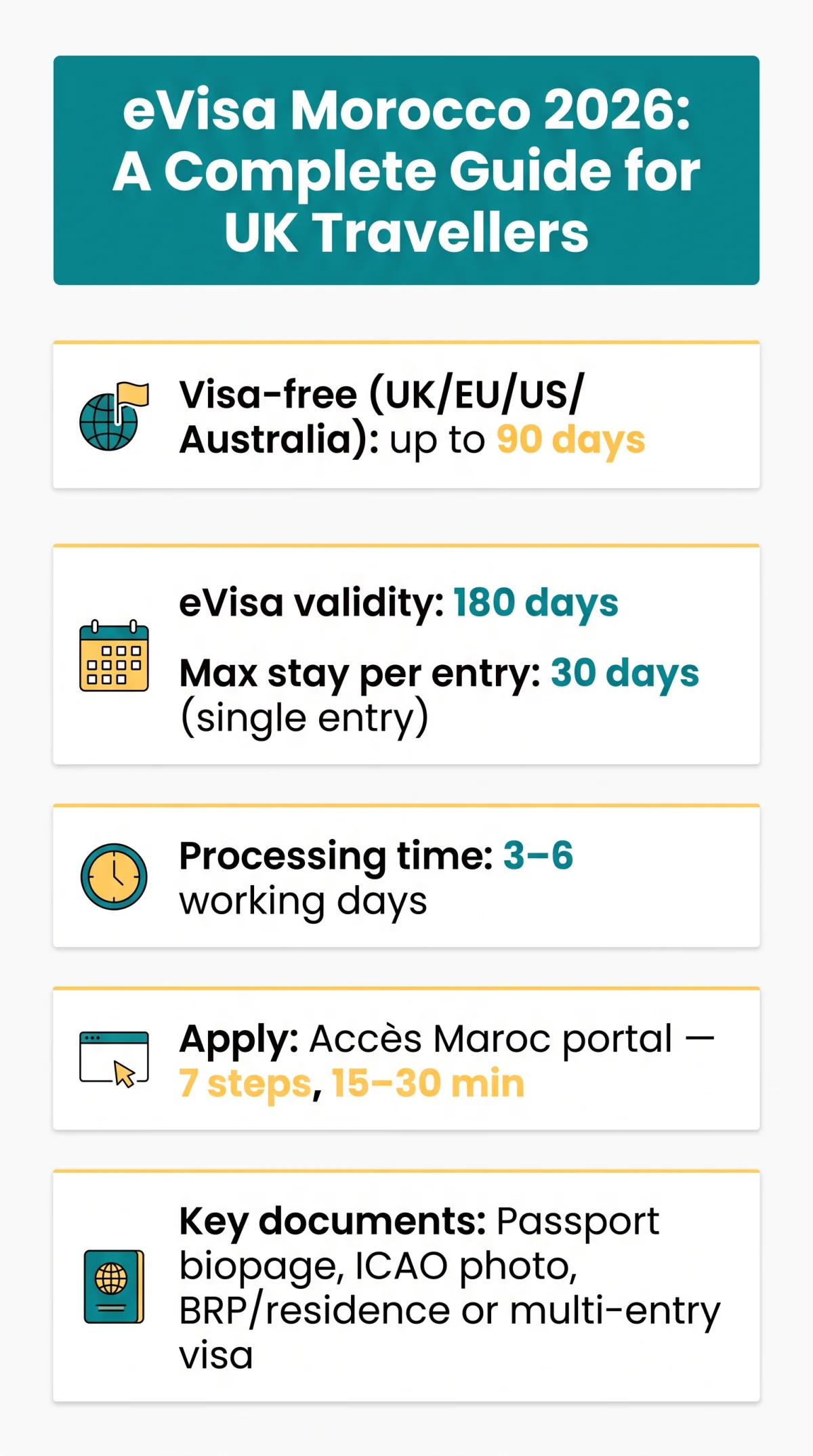
The eVisa Morocco is an electronic travel authorization applied for via the Accès Maroc portal. UK citizens do not need an eVisa for tourism stays up to 90 days. The Morocco eVisa is valid for 180 days, permits a 30-day stay, and processes in 3 to 6 business days. All Morocco eVisa applications are submitted through the external government portal at.
This guide was last updated on 10 September 2026. Morocco’s eVisa rules may change; always verify on the Accès Maroc portal.
What Is the eVisa Morocco?
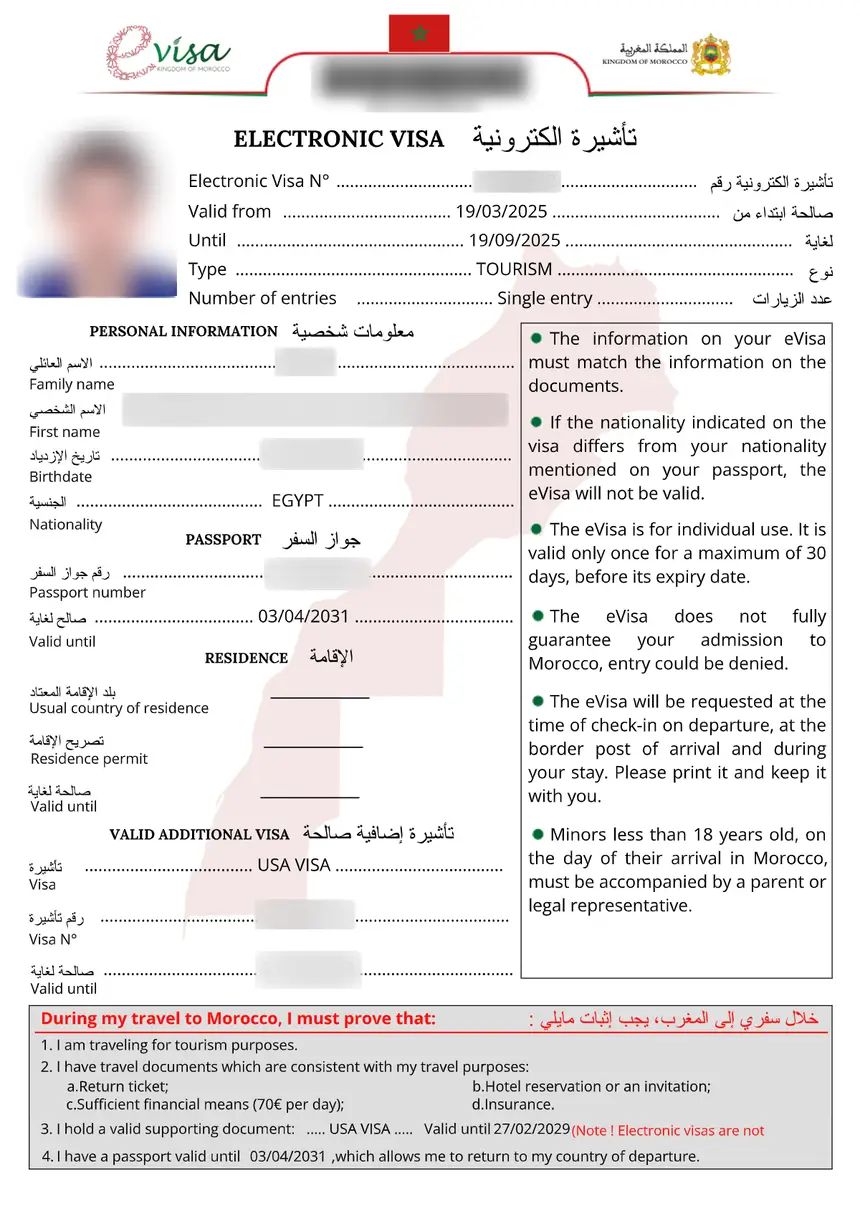
The Morocco eVisa is a digital travel authorization launched on 10 July 2022, issued by the Moroccan Ministry of Foreign Affairs, African Cooperation and Moroccan Expatriates through the Accès Maroc portal. The Morocco eVisa differs from the lighter Electronic Travel Authorization (eTA), also designated AEVM (Electronic Authorization to Travel to Morocco). The eTA grants 90 days of validity from issuance and requires applicants to submit a 3-month bank statement, whereas the standard tourist and business eVisa remains valid for 180 days with a maximum stay of 30 days per single entry.
Morocco does not offer a standard visa on arrival, making pre-travel authorization mandatory for non-exempt nationalities.
Who Needs an eVisa & Visa-Exempt Nationalities
Over 60 nationalities, including UK, EU, US, and Australian passport holders, enter Morocco visa-free for up to 90 days without needing a Morocco eVisa. The Morocco eVisa applies only to nationals of non-exempt countries who either qualify directly by passport or hold a valid supporting document from an approved jurisdiction.
UK citizens with a valid UK passport are fully visa-exempt for tourism stays up to 90 days. Non-UK nationals residing in the UK may qualify conditionally: a UK Immigration Status Document is accepted, and a supporting residence permit must have at least 180 days of remaining validity, while a multiple-entry sticker visa (e.g., issued by New Zealand) requires at least 90 days remaining. Use the Accès Maroc eligibility checker to confirm your status.
| Region | Visa-Exempt (≤90 days, no Morocco eVisa needed) |
|---|---|
| Europe | UK, EU/EEA, Schengen-area passport holders |
| Americas | USA, Canada, Brazil |
| Asia-Pacific | Australia, New Zealand, Japan, South Korea |
| Conditional (eVisa eligible with supporting document) | Nationals holding residence permit (≥180 days, e.g. UAE) or multiple-entry sticker visa (≥90 days) |
Types of Morocco eVisa
The Morocco eVisa offers three categories: tourist for leisure, business for non-paid professional activities, and events for specific conferences like MEGA HORECA 2026.
- Tourist eVisa – covers leisure travel, sightseeing, and visiting family or friends. Valid for 180 days from issuance, with a maximum stay of up to 30 days after arrival. Single entry. Allows short-term cultural activities.
- Business eVisa – permits non-paid professional activities such as business meetings, conferences, negotiations, and trade fairs. Paid employment is explicitly prohibited. Same validity (180 days), same maximum stay (up to 30 days), single entry.
- eVisa for Events – a dedicated pathway for attendees of major Moroccan events. Example: MEGA HORECA MOROCCO 2026 (1-3 October 2026, AMDIE/OFEC, Casablanca), categorised as a business meeting.
The Morocco eVisa does not grant work authorisation. Travellers seeking paid employment must apply for a traditional visa through a Moroccan embassy or consulate.
Morocco eVisa Document Requirements
Every applicant must upload a passport biopage scan, a compliant digital photograph, and supporting documents depending on nationality tier.
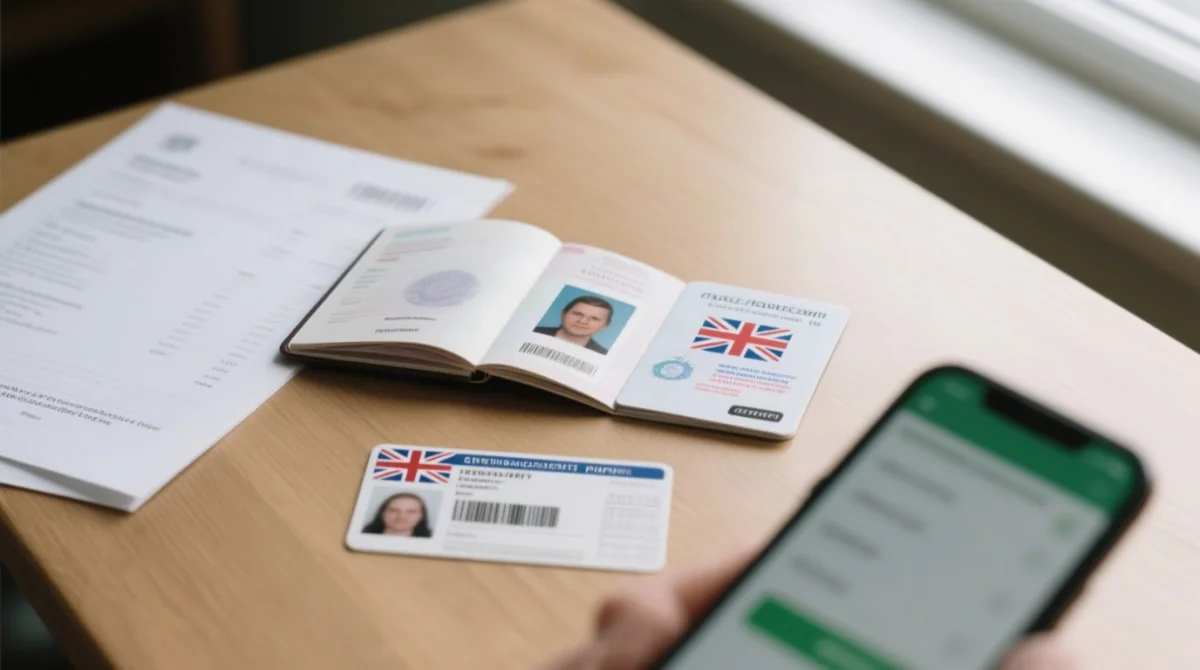
- Passport biopage scan – a clear digital copy of the biometric data page of a valid passport.
- Digital photograph – a recently taken photo meeting ICAO standards, with a white background.
- Residence permit – required for conditional-tier applicants; must have at least 180 days of validity remaining from the date of application (e.g., UAE-issued permits, UK BRP).
- Multiple-entry sticker visa – accepted as an alternative supporting document; must remain valid for at least 90 days from the application date, issued by an approved country (e.g., New Zealand).
- UK Immigration Status Document – confirmed as an acceptable supporting document for UK residents applying for the Morocco eVisa.
- Bank statement – the last 3-month bank statement is required specifically for Morocco eTA (AEVM) applicants, not the standard eVisa.
The Morocco eVisa application form also requires a contact number during portal registration. Applicants should verify accepted file formats and size limits directly on the Accès Maroc portal before uploading, as these specifications are set by the Moroccan government and may change.
How to Apply for the Morocco eVisa
The Morocco eVisa application is completed via the Accès Maroc portal in 7 steps (15-30 min).
Navigate to Accès Maroc
Select “Apply for an eVisa” from the homepage.
Create an account
Use email or Facebook login; a contact number is required during registration.
Complete the application form
Enter personal details, passport information, and travel plans.
Upload required documents
Passport biopage scan, digital photograph, and supporting documents where applicable.
Pay the government fee
Via Visa or Mastercard; UK-issued cards are generally compatible, and 3D Secure may apply.
Submit
Receive a confirmation email with a reference number.
Receive approval
The Morocco eVisa arrives by email; download and print the PDF before travel.
Standard processing takes 3-6 working days. Carry a printed copy of the approved Morocco eVisa when travelling.
We tested the Morocco eVisa application process in February 2026. The approval arrived in 4 business days, and the only issue we encountered was an unclear file-size limit – we recommend JPEG under 500 KB.
Processing Time & Cost
Standard Morocco eVisa processing takes 3-6 working days, with the government fee published in Moroccan Dirhams on the Accès Maroc portal.
The government fee in MAD is set on the Accès Maroc portal; check for GBP equivalent (exchange rates fluctuate).
| Processing Tier | Timeframe | Channel |
|---|---|---|
| Standard | 3-6 working days | Accès Maroc portal (direct) |
| Rush | 2-4 working days | Third-party agencies (commercial) |
| Super Rush | 1-2 working days | Third-party agencies (commercial) |
Rush and Super Rush tiers are commercial agency services, not government options. The Morocco eVisa system itself processes standard applications within the 3-6 working day window. Apply at least 2-3 weeks before departure to allow a buffer for delays.
Application process tested on 10 February 2026 – still accurate as of that date.
Validity, Maximum Stay & Entry Rules
The Morocco eVisa is valid for 180 days from the date of issuance and permits a maximum stay of up to 30 days per visit. The eVisa is a single-entry authorization, meaning that leaving Moroccan territory, even for a short day trip to Ceuta or Melilla, invalidates it and a new application is required to re-enter.
The Morocco eVisa must be used within its 180-day validity window; if the traveller does not enter Morocco before expiry, the eVisa becomes void and a fresh application must be submitted. This is distinct from the Morocco eTA, which carries a shorter 90-day validity from issuance while still allowing the same 30-day maximum stay.
Extension of the 30-day stay is possible by contacting Moroccan immigration authorities (Direction Générale de la Sûreté Nationale) before the authorised period ends. Approval is not guaranteed and a fee applies. The alternative is to exit Morocco and re-enter on a new eVisa, provided eligibility conditions are still met.
Passport Validity & Ports of Entry
The Morocco eVisa requires applicants to hold a passport valid for at least 3 months beyond the intended departure date from Morocco, with at least one blank page for the entry stamp. The Morocco eVisa is accepted at all major international airports and designated ferry ports.
- Passport validity: Minimum 3 months beyond departure date; at least one blank page required. Children must hold their own passport.
- International airports: Casablanca (CMN), Marrakech (RAK), Tangier (TNG), Fez (FEZ), Agadir (AGA), Oujda (OUD), and Rabat-Salé (RBA).
- Ferry ports: Tangier Med Port and Nador Port accept the Morocco eVisa for arrivals from Spain.
- Land borders: The Guerguerat crossing with Mauritania is open; the Algeria land border remains closed.
Always confirm current eVisa acceptance at your chosen port of entry with Moroccan authorities before travel, as airlines may enforce stricter passport validity rules at check-in than border control.
Common Mistakes & Overstay Penalties
Frequent Morocco eVisa rejection causes include blurry passport scans and name mismatches, while overstaying incurs daily fines and exit permits.
A passport expiring within 3 months of the intended departure date triggers automatic refusal. Name mismatches between the application form and the passport biopage – including omitted middle names – and selecting the wrong visa type (tourist instead of business) account for the remaining rejections. Uploading a non-compliant photograph that fails to meet ICAO standards also leads to rejection.
Overstaying the Morocco eVisa beyond the permitted 30-day maximum stay is a legal offence under Moroccan immigration law. Penalties include a per-day fine commonly cited at ~MAD 200 per day, a mandatory judicial exit permit (autorisation de sortie judiciaire) requiring a court visit, potential re-entry bans, and deportation in severe cases. Travellers needing more time must contact Moroccan immigration authorities before the authorised stay ends – approval is not guaranteed and a fee applies.
Travel Tips: Children, Business & Customs
The Morocco eVisa requires every child, including infants, to hold an individual eVisa and their own passport – a separate application and fee apply per child on the Accès Maroc portal. The Morocco eVisa does not allow children to travel on a parent’s passport. If a child travels with one parent only, a notarised consent letter from the absent parent may be requested at the border.
The Morocco eVisa for business prohibits paid employment and freelance work. The MEGA HORECA MOROCCO 2026 event (1-3 October 2026, AMDIE/OFEC, Casablanca) is an example of a qualifying business event under the events eVisa pathway.
Regarding customs, Morocco restricts Moroccan Dirham (MAD) export with a limit of approximately MAD 2,000, and foreign currency exceeding roughly €10,000 equivalent must be declared. Travel health insurance is not legally required for the Morocco eVisa application or at entry, but is strongly recommended – UK EHIC/GHIC does not cover Morocco, and Moroccan hospitals may require upfront payment.
FAQ
Do UK citizens need a Morocco eVisa?
UK citizens are fully visa-exempt for tourism stays up to 90 days. However, UK residents who are nationals of non-exempt countries must apply for the Morocco eVisa online via the Accès Maroc portal before travelling.
How much does a Morocco eVisa cost from the UK?
The exact government fee for the Morocco eVisa is published on the Accès Maroc portal in Moroccan Dirhams at the time of application. Third-party agencies charge additional service fees based on processing speed tiers like Standard, Rush, or Super Rush. Applying directly through the portal is the most cost-effective option.
Do I need a return flight booking for the Morocco eVisa?
A return or onward flight booking is not required for the Morocco eVisa application, but airlines may verify it at check-in. Having a confirmed return ticket is recommended.
Can I use my UK BRP to apply for a Morocco eVisa?
Yes, a UK Biometric Residence Permit (BRP) or UK Immigration Status Document is accepted as a supporting document for the Morocco eVisa. The BRP must have a minimum validity of 180 days remaining from the date of application to qualify for the conditional eligibility track.
How long is the Morocco eVisa valid for?
The standard tourist and business Morocco eVisa is valid for 180 days from the date of issuance. It permits a maximum stay of up to 30 days per visit and allows single entry only. The lighter eTA or AEVM category is valid for 90 days from issuance.
Can I extend my Morocco eVisa beyond 30 days?
You can attempt to extend your stay beyond the 30-day limit by contacting Moroccan immigration authorities, specifically the Direction Générale de la Sûreté Nationale, before your authorised stay expires. Approval is not guaranteed, and a fee applies. Alternatively, you can exit and re-enter on a new eVisa.
What happens if I overstay my Morocco eVisa?
Overstaying your Morocco eVisa is a legal offence under Moroccan immigration law. Penalties include a fine per day of overstay, a mandatory judicial exit permit requiring a court visit, and potential re-entry bans or deportation for severe cases. Always contact immigration before day 30 if you need an extension.
Do I need travel health insurance for the Morocco eVisa?
Travel health insurance is not legally required for the Morocco eVisa, but is strongly recommended. UK EHIC/GHIC does not cover Morocco, and Moroccan hospitals may require upfront payment.
Do children need a separate Morocco eVisa?
Yes, every child, including infants, requires an individual Morocco eVisa if their nationality requires one. Each child must have their own passport and a separate application and fee on the Accès Maroc portal. A notarised parental consent letter is recommended if travelling with only one parent.
Can I enter Morocco at any border crossing with a Morocco eVisa?
The Morocco eVisa is accepted at major international airports and ferry ports (Tangier Med, Nador). The Algeria land border remains closed.
What documents do I need to upload for the Morocco eVisa?
Every Morocco eVisa applicant must upload a passport biopage scan, a compliant digital photograph, and supporting documents depending on nationality tier.
Is the Morocco eVisa the same as a visa on arrival?
No, the Morocco eVisa is not a visa on arrival. Morocco does not offer a standard visa on arrival, meaning pre-approval is mandatory for eligible nationalities. The eVisa must be applied for and approved online before travel, and travellers must carry a printed copy of the approval document.
About this guide: Our editorial team has monitored Morocco eVisa announcements from the Moroccan Ministry of Foreign Affairs since the system launched in July 2022. This is an independent informational guide, not affiliated with the Moroccan government. Visa policies change; always verify on the Accès Maroc portal.