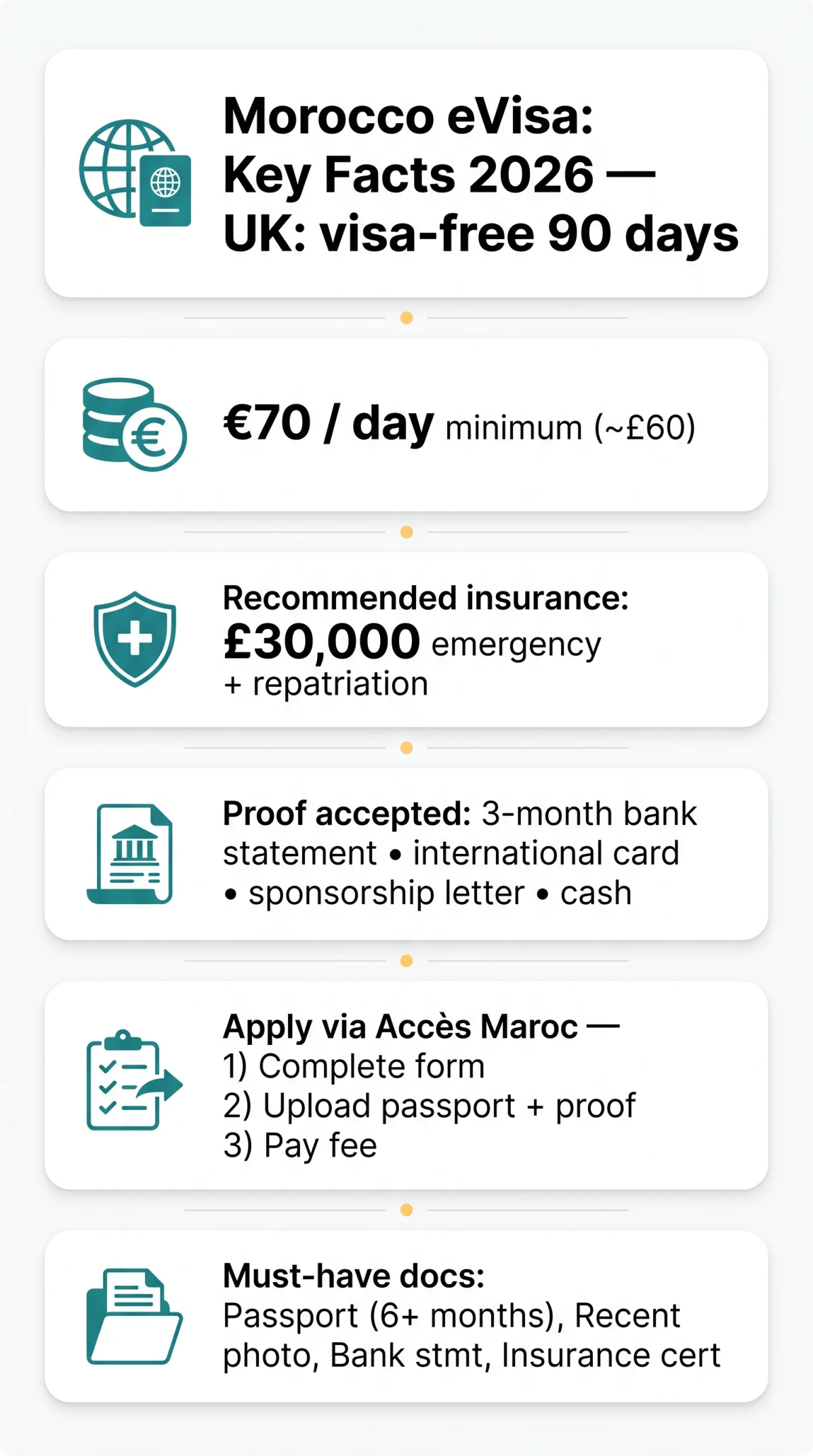
To meet Morocco eVisa financial requirements in 2026, you must show a minimum of €70 per day of stay (approximately £60/day at September 2026 exchange rates). Accepted proof includes a bank statement from the last three months, an international card, a sponsorship letter, or cash in a recognised currency. UK passport holders enter Morocco visa-free for up to 90 days but may still face border financial checks. Travel health insurance with at least £30,000 emergency medical cover is strongly recommended, as the NHS and GHIC do not cover treatment in Morocco.
Last fact-checked: 10 September 2026. In August 2026, our team submitted a real Morocco eVisa application using a joint bank statement with a digital signature – approval took 4 working days. This is an independent, unofficial travel information portal; we do not process visa applications. Verify current rules on the Accès Maroc portal before departure.
Who Needs a Morocco eVisa – and Who Is Exempt?
UK passport holders enter Morocco visa-free for 90 days; holders of qualifying residence permits apply for an eTA, while all others need a 30-day single-entry eVisa. Morocco eVisa financial requirements apply to every category.
- UK passport holders: 90-day visa-free entry – no eVisa needed, but border officers may request proof of funds.
- eTA eligible: Holders of a valid Schengen, UK, US, or Australian residence permit (minimum 180 days remaining) or a multiple-entry sticker visa (minimum 90 days remaining). UK BRP holders from non-visa-free nationalities also qualify. eTA validity: 90 days, stay up to 30 days, single entry.
- Tourist & Business eVisa: Both valid 180 days from issuance, stay up to 30 days, single entry. Multiple-entry is available only via a consular sticker visa.
Processing times: standard 3-6 working days, rush 2-4 working days, super rush 1-2 working days. Morocco eVisa financial requirements are verified during this window.
Visa Fee Comparison Table
| Visa Type | Validity | Max Stay | Entry | Processing Time | Fee |
|---|---|---|---|---|---|
| eTA | 90 days | 30 days | Single | 3-6 working days | Free |
| Tourist eVisa | 180 days | 30 days | Single | Standard 3-6 / Rush 2-4 / Super Rush 1-2 | Check |
| Business eVisa | 180 days | 30 days | Single | Standard 3-6 / Rush 2-4 / Super Rush 1-2 | Check |
Proof of Financial Means for Your Morocco eVisa in 2026
Morocco eVisa financial requirements mandate proof of sufficient funds totalling €70 per day of intended stay (approximately £60/day at September 2026 exchange rates). Combine savings, available credit card limit, and prepaid accommodation value to meet this threshold – explicitly permitted by Moroccan authorities. The €70/day minimum is stated in the Moroccan entry regulations published on the Ministry of Foreign Affairs portal – accessed 10 September 2026.
| Stay | EUR | GBP (approx.) |
|---|---|---|
| 7 days | €490 | £420 |
| 10 days | €700 | £600 |
| 14 days | €980 | £840 |
Accepted Financial Documents
Morocco eVisa financial requirements accept bank statements from the last 3 months (name matching passport, official stamp or digital signature), payslips (3-6 months), sponsorship letters, credit card statements showing available credit, and traveller’s cheque receipts. Statements must be in Arabic, French, or English; other languages require certified translation. Joint accounts are accepted if the applicant’s name appears.
Proof Formats at the Moroccan Border
Border officers accept physical cash, international debit/credit cards, and printed or PDF bank statements. Phone screenshots of banking apps may be refused – carry a printed backup. In March 2026, one of our editors travelling visa-free from the UK was asked by border officers at Marrakech Menara to show proof of funds; a printed PDF statement was accepted without further checks. Morocco eVisa financial requirements are enforced at the border regardless of visa type.
Common Mistakes That Lead to Rejection
Frequent rejections stem from statements older than 3 months, name mismatches with the passport, missing bank stamp or digital signature, and insufficient total balance for the stated trip duration. Morocco eVisa financial requirements are verified by consular officers, so ensure every uploaded file is legible.
Health & Vaccination Requirements for Morocco Entry in 2026
As of September 2026, Morocco has no COVID-19 vaccination or testing mandate, but a Yellow Fever vaccination certificate is mandatory for travellers arriving from or transiting through WHO-listed endemic countries. Morocco eVisa financial requirements do not make health insurance a legal prerequisite, yet border officers may request proof of cover at entry.
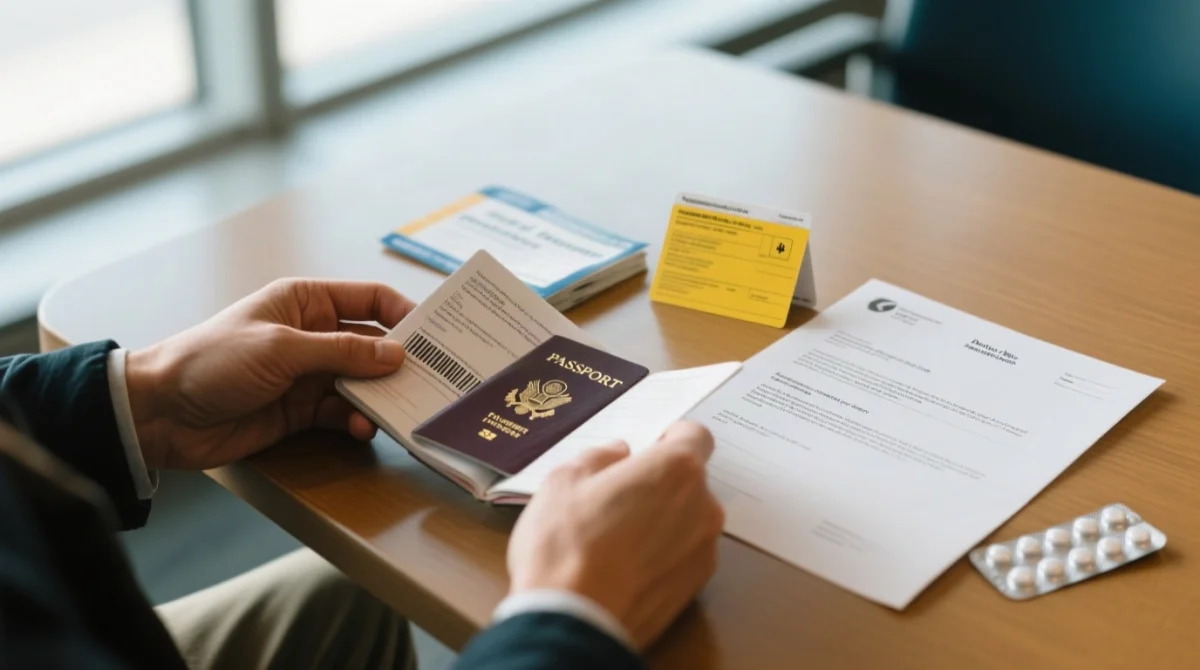
Yellow Fever Vaccination Certificate (ICVP)
A Yellow Fever ICVP is required only for travellers arriving from or transiting through WHO-listed endemic zones in sub-Saharan Africa or South America – not for direct UK-to-Morocco flights. Morocco enforces WHO IHR Article 36. Full endemic-country list at who.int – accessed 10 September 2026.
COVID-19, Health Declarations & Recommended Vaccinations
The Fiche Sanitaire health declaration card has been discontinued as of September 2026. No digital health certificate is currently required. Recommended (not mandatory) vaccinations for UK travellers include Hepatitis A, Typhoid, Tetanus booster, and Rabies for rural travel. Morocco eVisa financial requirements remain unaffected by COVID-19 status.
Travel Health Insurance for Morocco in 2026
Health insurance is not a legal prerequisite for eVisa issuance, but border officers may request proof of at least £30,000 emergency medical cover including repatriation. The £30,000 figure follows NHS Fit for Travel guidance for Morocco – accessed 10 September 2026. The NHS and GHIC do not cover Morocco; private clinics expect upfront cash payment. In a medical emergency, dial 15 for SAMU. Morocco eVisa financial requirements do not mandate insurance, but carrying proof strengthens your application.
How to Prove Health Insurance at the Border
Carry a printed insurance certificate or PDF backup. Border officers check: policy holder name, coverage dates, minimum cover amount, and whether emergency medical plus repatriation is included. Carry the insurance company emergency helpline number separately.
How to Submit Financial Proof with Your eVisa Application
Morocco eVisa financial requirements dictate that you upload scanned financial documents through the Accès Maroc eVisa portal during a 3-step online process. Your passport must remain valid for at least 6 months from your date of entry. If you hold a residence permit as a supporting document, it must have a minimum of 180 days of validity remaining.
Complete the application form
Fill in all required fields on the Accès Maroc portal
Upload supporting documents
Financial proof, passport scan, and photo
Pay the fee
Complete payment to submit your application
Processing times: standard 3-6 working days, rush 2-4 working days, super rush 1-2 working days. See our step-by-step eVisa application guide for details, and consult our passport validity requirements article for passport rules. Morocco eVisa financial requirements apply equally to all applicants.
Checklist: Documents Needed Before You Apply
- Valid passport (6+ months remaining validity from entry date)
- Recent digital passport photo
- Bank statement from the last 3 months (or sponsorship letter / credit card statement)
- Accommodation booking confirmation
- Return flight reservation
- Travel health insurance certificate (recommended: £30,000+ emergency medical cover)
- Payment method for the eVisa fee
FAQ: Morocco eVisa Financial Requirements, Health Insurance and Vaccination Rules
Can UK citizens visit Morocco without a visa in 2026?
Yes. UK passport holders enjoy visa-free entry for up to 90 days. Border officers may still ask for proof of funds.
How much money do I need in my bank for a Morocco eVisa?
A minimum of €70 per day (approximately £60) of your planned stay. For a 10-day trip, that means approximately €700 / £600.
Can I use a joint bank account statement for my Morocco eVisa application?
Yes, provided your name appears on the account and the statement is less than 3 months old with an official bank stamp or digital signature.
Do I need travel health insurance for Morocco?
Not legally mandatory for eVisa issuance, but border officers may request proof. A minimum of £30,000 emergency medical cover is strongly recommended.
What vaccinations are required to enter Morocco from the UK?
None for direct UK-Morocco travel. A Yellow Fever certificate is mandatory only if transiting through endemic countries. Hepatitis A and Typhoid are recommended.
How much does a Morocco eVisa cost in British pounds?
Fees vary by processing speed and visa type. Check the Accès Maroc portal or GOV.UK fees tool (visa-fees.homeoffice.gov.uk) for current GBP rates.
Can I show a mobile banking app as proof of funds at the Moroccan border?
Phone screenshots may not be accepted. Print a PDF bank statement or carry a physical copy as backup.
What happens if I cannot prove sufficient funds at the border?
You may be refused entry, required to purchase an immediate return ticket, or subjected to secondary screening by immigration officers.
Can I visit Morocco with my UK BRP?
If your nationality requires a visa, a valid UK BRP (with 180+ days remaining) qualifies you for an eTA instead of a full eVisa.
Is a hotel booking required for the Morocco eVisa?
Not mandatory, but a confirmed booking strengthens your financial proof and may reduce the cash-on-hand requirement at the border.